
What Your Skin Could Be Telling You About Your Health
Our skin is far more than something we see in the mirror.
It is our largest organ and often gives us clues about what’s happening inside the body long before blood tests or symptoms appear.
As a facialist, I don’t diagnose medical conditions. However, over the years I’ve noticed that the skin often tells a story, and sometimes that story is worth investigating further with your GP.
One area receiving increasing attention is the relationship between certain skin changes and insulin resistance.
What is insulin resistance?
Insulin is a hormone that helps move glucose (sugar) from your bloodstream into your cells where it can be used for energy.
When the body becomes resistant to insulin, it has to produce more and more of it to keep blood sugar under control.
This can continue for years before someone develops pre diabetes or Type 2 diabetes.
Many people have no obvious symptoms.
Sometimes, however, the skin begins to give subtle clues.
Skin tags
Skin tags are one of the most common skin growths I see.
They are small, soft, harmless growths that often appear around the neck, under the arms, beneath the breasts or in the groin.
While skin tags are extremely common and become more frequent with age, having multiple skin tags, particularly around the neck, has been associated with insulin resistance in several studies.
This does not mean everyone with skin tags has insulin resistance.
Many people simply develop them through friction, ageing or genetics.
However, if they are appearing in increasing numbers, especially alongside weight gain around the abdomen or a family history of diabetes, it may be worth discussing with your GP.
Acanthosis Nigricans
One of the strongest skin signs linked to insulin resistance is a condition called Acanthosis Nigricans.
This appears as darker, thicker, velvety skin, most commonly around the back of the neck, armpits or groin.
People often think the skin looks dirty or that it simply needs exfoliating.
In reality, the colour change is happening within the skin itself.
This condition is strongly associated with elevated insulin levels and should always be assessed by a healthcare professional.
Keratosis Pilaris
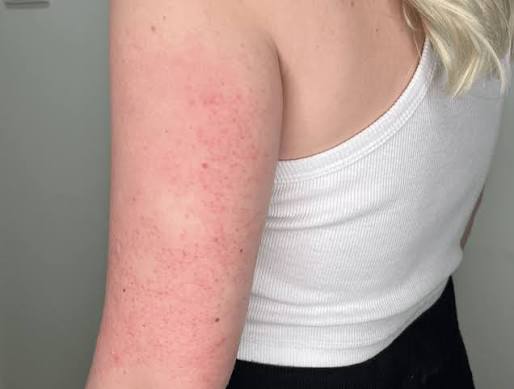
Those tiny rough bumps on the backs of the arms or thighs are known as Keratosis Pilaris, often called “chicken skin”
Keratosis Pilaris is caused by a build up of keratin blocking the hair follicles.
It is extremely common and is often inherited.
Some emerging research has explored whether insulin resistance and metabolic health may influence skin barrier function and inflammation in some people with Keratosis Pilaris, but the evidence is still limited.
At present, Keratosis Pilaris is not considered a recognised sign of insulin resistance on its own.
Instead, it is usually linked to dry skin, genetics and conditions such as eczema.
Supporting the skin barrier with gentle skincare is often far more beneficial than aggressive exfoliation.
Stubborn acne
Adult acne can have many causes.
Hormones.
Stress.
Certain medications.
Cosmetics.
Diet.
For some people, particularly women with polycystic ovary syndrome (PCOS), insulin resistance may contribute to persistent acne by increasing androgen hormones and stimulating excess oil production.
Again, acne alone does not mean someone has insulin resistance, but when combined with irregular periods, unwanted facial hair or weight changes, it may warrant further investigation.
Slow wound healing
Cuts, scratches or spots that seem to take a long time to heal can sometimes be associated with elevated blood sugar levels.
High glucose can affect circulation and reduce the body’s ability to repair tissue efficiently.
If you’ve noticed wounds healing much more slowly than normal, it’s worth mentioning this to your GP.
Why I focus on the skin barrier
My focus is never just on making the skin look healthier.
My aim is to support the skin so it can function as nature intended.
That is why I use Dermaviduals, a corneotherapy based skincare range that strengthens and repairs the skin barrier rather than stripping it away.
I also work with Esse Skincare, which supports the skin’s microbiome, helping beneficial bacteria thrive and reducing unnecessary inflammation.
Looking beyond the surface
Our skin is wonderfully intelligent. Sometimes a skin concern is simply cosmetic. Sometimes it reflects genetics. And occasionally it can be one small piece of a much bigger picture.
If you’ve noticed multiple new skin tags, dark velvety patches of skin, or other changes that concern you, don’t ignore them.
They don’t necessarily mean something is wrong, but they may be worth discussing with your GP.
As facialists, we spend more time observing the skin than almost anyone else.
Sometimes that means recognising when the skin is asking us to look a little deeper.
Disclaimer
This article is for educational purposes only and is not intended to diagnose or treat any medical condition. If you have concerns about changes to your skin or your health, please seek advice from your GP or another qualified healthcare professional.